
Andrew Sherman

Audio By Carbonatix
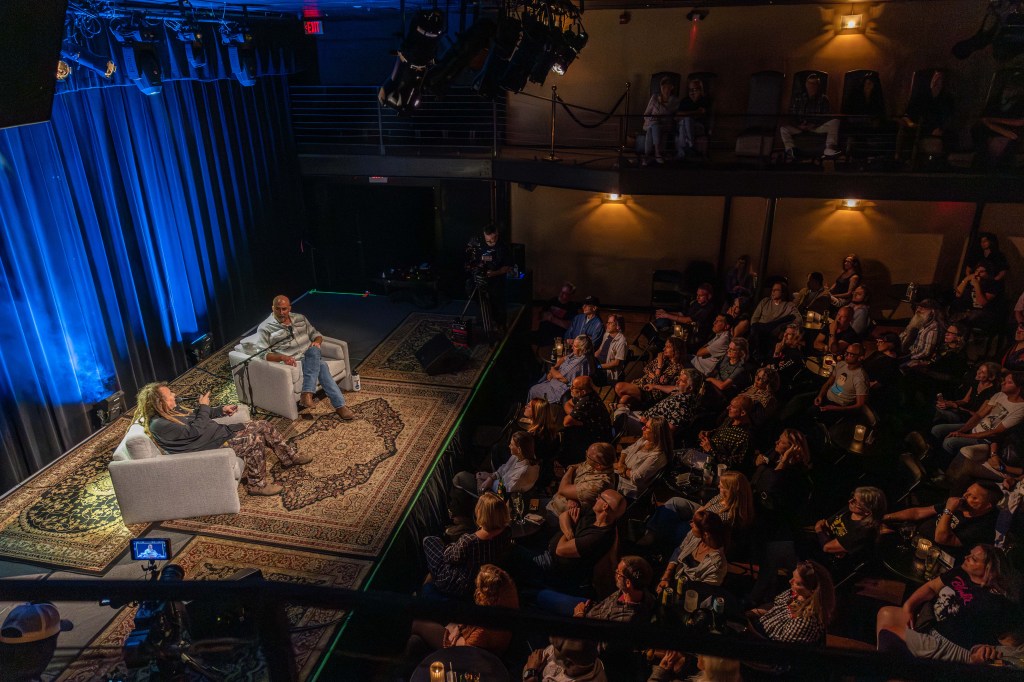
Over the summer, it was story time with Jeffrey Liles and Robert Wilonsky. Two Dallas music culture historians delved into in-depth topics for a one-night-only storytelling experience.
The audience was instructed to write one single word on an index card. A band, genre, concert, or album, the word was the inspiration and jumping-off point. The show is spontaneous, leaving people to be engaged and inspired, as Wilonsky provides the necessary context and chronological order needed to fill in Liles’ timeline.
This weekend, Liles and Wilonsky are doing it again for Storytellers at The Kessler: Cottonmouth, Texas Chapter 2. Wilonsky will return for hosting duties while Liles is back to reflect on a transformative time in Dallas music history.
When news happens, Dallas Observer is there —
Your support strengthens our coverage.
We’re aiming to raise $30,000 by December 31, so we can continue covering what matters most to you. If the Dallas Observer matters to you, please take action and contribute today, so when news happens, our reporters can be there.
Below is our conversation with Liles, broken into two parts, with the second part to be published on Friday. His breadth of Dallas knowledge is vast and detailed, as if he lived it yesterday. As we delve into Deep Ellum in the 1980s, when it was a dormant warehouse district, we explore how bands went national by performing original songs and the parallels between the Prohibition era and The Theatre Gallery.
People have described you as a Dallas musician historian, a Dallas music legend, Godfather of the music scene.
I don’t know what all that is.
What do these titles mean to you?
Not much, to tell you the truth. That’s kind of like a hard thing to live up to. The Dallas music scene is super fluid. It’s always changing, and there are always different eras, styles and artists that come and go. For any one person to be designated that type of role seems disingenuous. I think they’re basically saying that I’m old.
Are there other people like you who are Dallas music historians?
Robert Wilonsky. More than I am, definitely. Robert’s an amazing guy. His family has ties to Deep Ellum that date back to before it became a music scene. Robert, I think more than any single person in Dallas, is pretty much the singular preeminent historian. That’s why I love doing these Storytellers events with him because he is so completely adept at telling all the backstory of the city itself, going back to the architecture, the real estate developers, every aspect of it and the cultural shifts that have happened over the years. He’s also a huge music lover. He’s an expert at all the different venues that we’ve had here in town over the last, say, 40 years.
He’s a little bit younger than I am. He is about three or four years younger than me. He kind of missed some of the stuff because he just wasn’t quite old enough yet. He’s one of those guys who, you know, digs, digs and digs for old recordings of live shows that happened in Dallas dating back to the ‘60s. He’s completely infatuated with all that stuff. So I love having these discussions with him in public because he’s great at filling in the gaps. He’s the kind of guy who can tell you what the weather was like on the night that U2 played at the Bronco Bowl in 1983. He literally has this incredible attention to detail. It’s a huge gift.
You and Robert are doing Storytellers at the Kessler again. Is this the first time you’ve both sat down and done this together?
When we first opened the Kessler in the early 2010s, we had a Storytellers at the Kessler series. We had nights like those with Guy Clark, Joe Ely, Ray Wylie Hubbard, and Marc Ribot, all these Storyteller nights where we had different music writers come in and interview the artists on stage during the middle of their performances. Robert was one of the first guys who was one of the master of ceremonies for it. A while back, we decided to start bringing back the Storyteller series. When I’m at work at night, people ask me about something and I’ll end up standing there telling them a story about something. And then they’re like, ‘Dude, you need to write a book.’ And I’m like, ‘I don’t want to write a book.’ I just prefer to do it in a room full of people who are just sitting there listening and engaged with it.
Andrew Sherman
You’ve worn a lot of hats in your lifetime. You were in a band, a videographer and a writer for The Observer. What else have you done?
Well, I was a radio DJ on KNON. I started doing that in the ‘80s. Back then, I was literally the first DJ anywhere to play Eazy-E and N.W.A. on the radio. My band at the time was called Decadent Dub Team; it was kind of an industrial hip-hop group. And this woman from Los Angeles, named Kim Buie, was a talent scout for Island Records. She was the one who discovered N.W.A. playing in a roller rink in Compton. At the same time she was trying to sign us to Island, she was trying to sign them to Island as well, before they had to deal with Priority.
So, when we would go out there to have meetings with her, the record label and go out to dinner. There’s a whole kind of courting process that A&R people would go through. A lot of times, she would take us out with Dre and Eric and Ren and Ice Cube, we would all go to dinner together and hang out. We became really good friends. Eazy-E used to send me these tapes of stuff they were working on in the studio. One night, I got the tape of “Boyz-n-the Hood” in the mail and literally had a radio show that night and I played it that afternoon. I got it in the mail before it was ever a record. So that was the first time it ever got played on the radio anywhere.
Many transplants come to Dallas. If someone is new to the Dallas music scene, what story do you tell them? What is the first thing you want to tell?
Where are you from? Where did you move here from?
I’m originally from Oregon and then I moved to New York to start my career. Then, after New York, I came to Dallas.
Well, usually I try to find out where somebody’s from and then see if there’s some kind of connection to Dallas from where they’re from.
Okay.
When I was at The Roxy Theatre, many Dallas bands came through and played there. When I was living here, back before there was an SXSW, there was this thing in New York called the New Music Seminar. During the ‘80s, it was the template for what SXSW became. Back then, a lot of Dallas fans would go up there and play. If someone tells me they’re from out of town or they’re from a different place or wherever, I usually try and come up with something that ties to where they’re from and where they would find a commonality from our scene here to where they’re from, what they’re used to and what they’re into.
There were crazy, crazy times in New York with the Dallas band up there. I remember going with Funland to see them play at CBGB. I went to New Music Seminar one year with Jim Heath of Reverend Horton Heat. We stayed at the Chelsea Hotel. We met the guys at Asleep at the Wheel who gave us their credentials at the festival. So we walked around for a week pretending we were Asleep at the Wheel, which was really funny.
Growing up here, what was the music scene like back then? More punk? Was it more of a counterculture uprising happening?
I’ll tell you exactly. When I was a teenager, Dallas was a copy band town, which meant if you were a musician, if you’re a kid who owned a guitar, and you were maybe thinking about being in a band or doing music for a living, the best you could really hope for, and this is during the ‘70s, was to get in a band that did other people’s music. All the venues in town basically were copy bands. There were bands that were playing ZZ Top songs, Thin Lizzy, Queen and stuff like that. That’s what your aspiration was to get the band to play Led Zeppelin songs. If you were doing that, there’s a ceiling. There’s only so much you can do. The best you could ever really aspire to was to be the best copy band in town. You were never going to get a record deal playing somebody else’s music.
Around 1980 and 1981, when punk rock and New Wave music began to gain popularity, a club on Maple Avenue called The Hot Klub emerged. Hot Klub was the first punk rock stronghold in Dallas. All of those bands played their own music. It was punk rock. It was their own songs, though. The next logical extension of that, two or three years later, was when Deep Ellum began to happen. This was in ’85. The Theatre Gallery was the first club that I ever booked. It was on Commerce Street in Deep Ellum. This was when Deep Ellum was still an empty warehouse district.
Essentially, what Theatre Gallery was was an empty warehouse where Russell Hobbs, the founder, would take raw construction materials and create lofts, stages, and other features within the art gallery space. He created it all without any permits, without any design or architectural plan in mind. He just would like build a giant tree house inside this warehouse.
The Theatre Gallery, as a performance art space, was known for featuring young bands from the suburbs, with each band representing a different suburb. You had Shallow Reign from North Texas. You had the New Bohemians from East Dallas. You had The Buck Pets, who were from Plano. You had Three on a Hill that was from Carrollton and Farmers Branch. The Trees were from Pleasant Grove. All these bands were from the various suburbs around town and they would bring all their friends from high school down to The Theatre Gallery to see them play. Back then, the drinking age was still 18. All of these kids would come to The Theatre Gallery and drink free beer, get to know each other and that’s what kickstarted the original music sound in Deep Ellum. All the guys who were playing cover band music back in the ’70s were starting to get old. They kind of get day jobs. At the same time, all these young kids were starting a whole youth movement based on originality, writing their own material.
A result of that, a lot of these bands started getting attention from A&R people on the East and West Coasts. So you had record labels sending their talent scouts to Dallas just to see all these bands playing at Theatre Gallery. During that time, the New Bohemians got a deal with Geffen, Rigor Mortis, who was a speed metal band from Arlington, they played at The Theatre Gallery, and they got a deal with Capitol. The Buck Pets got a deal with Island, Reverend Horton Heat got a deal with Sub Pop. All of these bands began to receive record deals. If you were a guy from the ’70s trying to play your copy band music, that was never going to happen. All of these artists having this ability to connect with their original music was a huge leap forward for the creative community in Dallas.
The Sound of Deep Ellum from 1987 was a launching pad. It was the point where they were already established. This project takes them to the next level.
By the time Kim came to Dallas and saw all these bands playing for the first time, they were already playing in front of 400 or 500 people a night.
So it wasn’t as if she was just discovering these bands playing in their garage. It wasn’t that at all. These bands had the ability to draw people to their shows, often precluding what you saw from touring acts coming through. New Bohemians drew 500-600 people every time they played. By comparison, the first time Red Hot Chili Peppers came through Dallas, they played for a hundred people. Same thing with Jane’s Addiction at the Theatre Gallery. The local bands were drawing more people than the touring acts that were coming through. That wasn’t all that unusual. It was because the community, like I said, all these different kids from all the different suburbs. All these kids met each other, created a vibrant music community from scratch. That’s really kind of a magical thing that happened just by pure geography.
How old were you when you were witnessing it?
I was about 23, 24. It began to spread out as well. Theatre Gallery and Profit Bar were really the first two venues down there, and Studio D. Studio D was a punk rock club. But when Studio D first opened, Frank Campagna, who now owns Kettle Art Gallery, that was his place. He wasn’t really referring to the neighborhood as Deep Ellum. We didn’t start acknowledging the name and the history of Deep Ellum until Theatre Gallery came along. Russell Hobbs met a local writer here named Alan Govenar. Alan was the one who told Russell all about the musical heritage of Deep Ellum during the Depression era. And Russell became fascinated with this connection between those musicians, including “Blind Lemon” Jefferson and Alex Moore, as well as all the blues artists who had played there, such as Huddie Ledbetter. He became infatuated with the connection between the historical significance of that era and what was happening in the neighborhood, particularly with the Theatre Gallery, and how the music scene was blossoming in the same space. Under the same pretext, there were chalk houses and illegal beer sales to the people who came to see the shows. That’s what we were doing at the Theatre Gallery: we were buying kegs every night. We didn’t have a proper bar. It’s $5 to get in and everybody got a beer cup. You’d just kept filling up your beer cup all night.
So Russell had seen the parallels between the way these venues had happened during the Prohibition era and what we were doing. He really started to leverage the identity of people and the historical significance of that. Initially, I was somewhat apprehensive about it. I wasn’t sure if it was enough of the same thing to draw a parallel there. But he was adamant about it. If anybody is the Godfather of the resurgence of Deep Ellum, it’s Russell Hobbs.
Storytellers at The Kessler: Cottonmouth, Texas Chapter 2 will take place on Saturday, Nov. 15, at 8 p.m. at The Kessler Theater, 1230 W. Davis St. Tickets are available starting at $32.42 on Prekindle.